

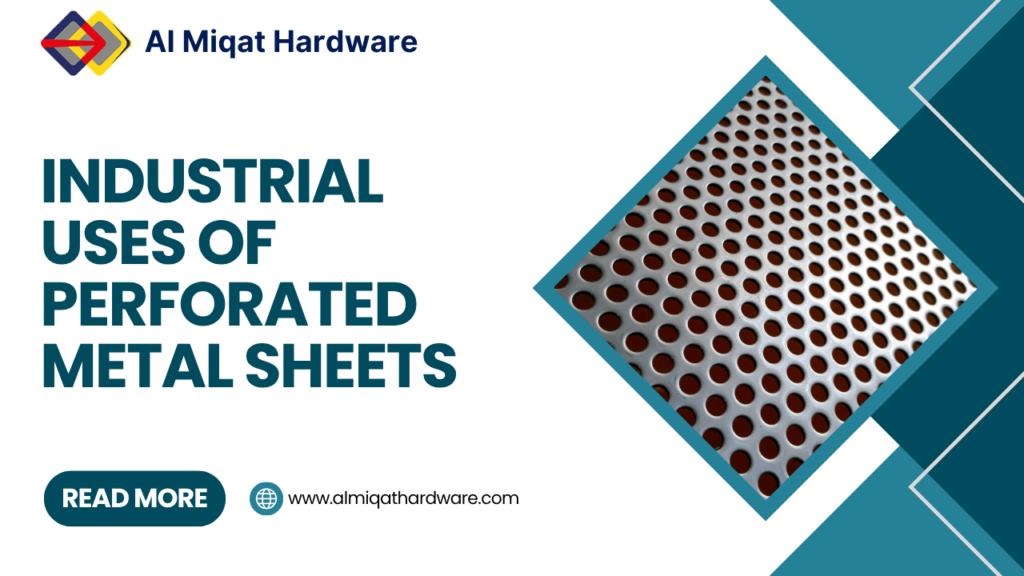
When people think of metal, they often imagine solid, impenetrable plates—massive walls of steel designed to block, hold, or support. However, some of the most innovative and essential applications of metal in the industrial world rely on a simple transformation: the addition of precision-engineered holes.
Perforated metal sheets are not just for architectural flair or decorative facades. In the world of manufacturing, logistics, and heavy industry, they are high-performance tools designed to solve complex engineering problems. At Al Miqat Hardware, we have seen firsthand how the right perforation pattern can change the efficiency, safety, and functionality of an industrial operation.
In this guide, we explore why perforated metal is a powerhouse component in modern industry and how you can leverage it for your own business applications.
What Makes Perforated Metal "Industrial Grade"?
Perforated metal is created by punching a precise pattern of holes—round, square, slotted, or decorative—into a sheet of metal. While the process sounds simple, the result is a material with unique mechanical properties:
- High Strength-to-Weight Ratio: By removing a portion of the metal, you reduce the weight of the sheet without significantly sacrificing structural integrity.
- Controlled Flow: The holes allow for the passage of air, light, liquids, and sound, providing a level of permeability that solid sheets cannot offer.
- Surface Grip: When processed with specific patterns, perforated metal creates a textured surface that provides excellent slip resistance.
5 Essential Industrial Applications
From the floors of a busy warehouse to the inner workings of a massive ventilation system, perforated metal is everywhere. Here is how it is being used to keep operations running smoothly.
1. Filtration and Separation Systems
One of the most common industrial uses for perforated metal is in filtration. Whether you are dealing with liquid, gas, or solid waste, perforated sheets act as the primary filter medium.
- Application: In food processing or chemical manufacturing, perforated screens are used to separate solids from liquids or to grade raw materials by size.
- Why it works: The precise hole sizing ensures that only the desired materials pass through, while the durability of the metal allows the screen to withstand high-pressure flows and abrasive substances that would quickly destroy plastic filters.
2. Acoustic Control and Sound Attenuation
Industrial environments are notoriously noisy. Machinery, compressors, and ventilation systems create a constant hum that can be hazardous to employee hearing and well-being.
- Application: Perforated metal is frequently used in the construction of acoustic panels and sound baffles.
- Why it works: When sound waves hit the perforated surface, they pass through the holes and are absorbed by insulation materials hidden behind the sheet. This dramatically reduces reverberation and echoes, creating a safer, more productive workspace.
3. Safety Flooring and Walkways
In factories, slip-and-fall accidents are a significant liability. Walkways and platforms made from standard smooth steel can become deadly if oil, grease, or water is spilled on them.
- Application: Many of our clients at Al Miqat Hardware opt for “embossed” or “dimpled” perforated sheets for mezzanine floors, catwalks, and stair treads.
- Why it works: The edges of the perforations provide a biting surface for footwear, offering superior traction even in slick environments. Furthermore, the holes allow debris and liquids to fall through, keeping the walking surface clean and dry.
4. Ventilation and Heat Dissipation
Electronic enclosures, engine housings, and furnace systems all share the same problem: heat buildup. Solid enclosures risk overheating, which can lead to catastrophic equipment failure.
- Application: Perforated metal serves as the ideal protective housing. It acts as a physical barrier against tampering and dust, while the open area (percentage of air space) allows for natural or forced airflow.
- Why it works: It prevents the accumulation of heat while still providing a rugged, impact-resistant shield for sensitive electronic components.
5. Architectural and Load-Bearing Guards
In a manufacturing setting, you need to protect your staff from rotating machinery, conveyor belts, and robotic arms.
- Application: Machine guards made from perforated sheets provide a clear view of the operation (for maintenance and monitoring) while keeping personnel at a safe distance.
- Why it works: It offers the best of both worlds: safety and visibility. A solid guard hides potential mechanical issues, whereas a perforated guard allows you to spot a belt fraying or a leak developing before it becomes a major problem.
Choosing the Right Sheet: Technical Considerations
Not all perforated sheets are created equal. When sourcing your materials from Al Miqat Hardware, you should consider these three factors to ensure you get the right performance:
The "Open Area" Percentage
This is the ratio of the hole area to the total sheet area.
- High Open Area (40%–60%): Best for maximum ventilation, sound absorption, and filtration. However, the sheet will be less rigid.
- Low Open Area (10%–30%): Best for high-load applications like flooring or machine guards where strength and impact resistance are the priority.
Material Composition
We stock perforated sheets in a variety of materials:
- Mild Steel: The most economical choice for general-purpose indoor applications.
- Stainless Steel (304/316): Essential for industries involving food, pharmaceuticals, or coastal environments where corrosion is a factor.
- Aluminum: The perfect choice when weight is a concern but you still need the benefits of a metal barrier.
Pattern Selection
While it may seem purely visual, the pattern matters. Round holes are the most common and provide the most structural strength. Slotted or square holes offer more “open area” and are preferred for filtration applications where flow rate is a critical metric.
Why Partner with Al Miqat Hardware?
At Al Miqat Hardware, we don’t just supply metal; we understand the engineering requirements behind your purchase. Whether you are building a custom filtration unit for your factory or upgrading your warehouse flooring for better safety, we offer expert guidance on sheet thickness, hole patterns, and material grades.
We understand that in an industrial context, there is no “off-the-shelf” solution for every problem. That is why we focus on providing high-quality, reliable perforated metal that you can trust to perform under pressure.
Ready to optimize your facility?
Stop by Al Miqat Hardware today to discuss your project. We can help you select the specific perforated configuration that will maximize your efficiency, enhance your safety, and provide the durability your operation demands.