

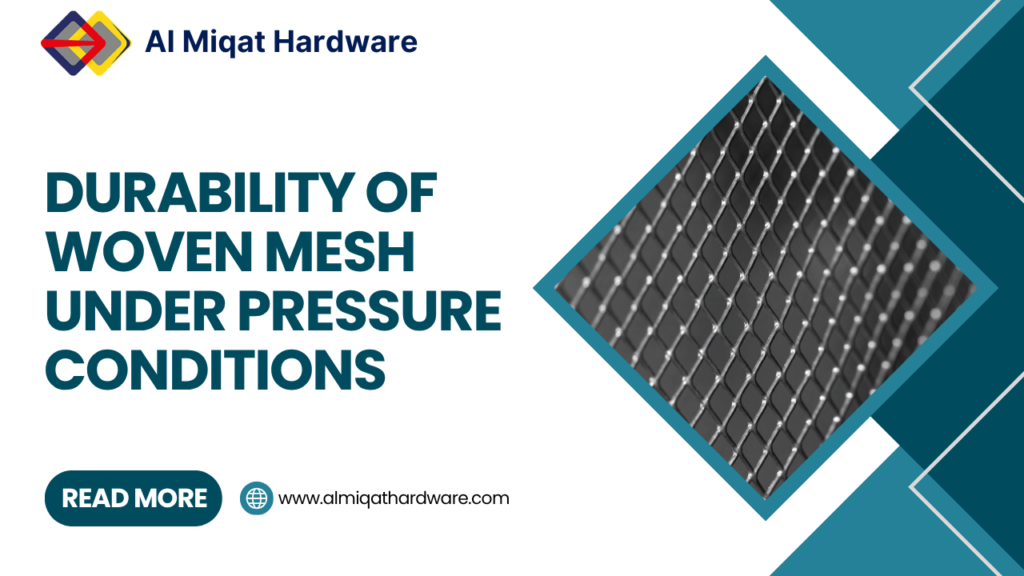
In the industrial world, “strength” is often misunderstood. We tend to equate it with thickness or mass, but in many of the most demanding applications—from filtration systems to structural support—true strength comes from clever engineering. This is where woven wire mesh truly excels.
At Al Miqat Hardware, we supply a wide range of industrial mesh products, and we often find that our clients are surprised by just how much mechanical pressure a relatively thin piece of woven wire can withstand. When you are dealing with high-pressure fluid flow, heavy vibration, or the physical stress of material separation, the secret isn’t just in the metal—it’s in the weave.
In this guide, we break down why woven mesh is a top-tier choice for pressure-intensive environments and how you can select the right specification for your operational needs.
What Makes Woven Mesh Different?
Unlike welded mesh, where wires are joined at intersections by heat, woven mesh is created by interlacing wires over and under one another in a loom, much like fabric. This interlacing creates a dynamic structure.
When pressure is applied to a welded joint, the stress is concentrated at the weld point, which can be the “breaking point” if the welding is uneven or brittle. In contrast, woven mesh distributes pressure across the entire length of the wire through the crimp and the interweave. This makes it far more resilient to mechanical stress and structural fatigue.
How Woven Mesh Handles Pressure
To understand durability, we have to look at the three primary “pressure conditions” an industrial mesh will face:
1. High-Pressure Fluid Flow
In filtration systems, fluids (liquid or gas) are often forced through a screen at high velocities. This creates “differential pressure,” which can cause weak mesh to deform or “pocket.”
- The Solution: Woven mesh is exceptionally good at maintaining its aperture (hole size) under differential pressure. Because the wires are physically locked into place by the weave, the screen does not stretch or warp easily, ensuring that your filtration process remains consistent and reliable even under heavy load.
2. Vibratory and Cyclic Stress
Many industrial processes involve constant, high-frequency vibration. This is the death knell for many rigid materials, as constant vibration leads to “work hardening” and eventual snapping.
- The Solution: Because woven mesh has a degree of inherent flexibility due to the interweave, it acts as a shock absorber. It can “flex” under vibration without snapping, making it the preferred choice for vibratory screens used in mining, food processing, and material sorting.
3. Impact and Abrasion
When heavy solid materials strike a screen, the pressure is delivered in a high-impact, concentrated force.
- The Solution: This is where the crimp of the wire comes into play. By using pre-crimped wires, manufacturers can create a locked, rigid structure that is significantly stronger than a flat-weave mesh. The crimp essentially “locks” the wires, preventing them from shifting or sliding, which keeps the impact load spread out across the entire panel rather than a single point.
Selecting the Right Specification
At Al Miqat Hardware, we don’t just sell “mesh”—we help you select the exact weave to survive your specific pressure conditions.
The Importance of the Weave Style
- Plain Weave: The most standard, “over-one-under-one” pattern. It is the most economical, but it is best for general-purpose applications rather than extremely high-pressure scenarios.
- Twill Weave: In this style, each wire passes over and under two or more wires. This allows for thicker wires to be used in a tighter mesh, providing much higher mechanical strength and better durability under high-pressure flow conditions.
- Dutch Weave: Here, the warp wires are thicker than the shute wires. This creates a very dense, high-strength filter that is specifically designed to handle extreme differential pressure.
The Gauge Factor
Pressure management is a balance between aperture (how much liquid/material you need to pass through) and wire diameter (how much force the wire can hold). A common mistake is to select a mesh that is too fine for the pressure it needs to withstand. Always check the load-bearing capacity for your required aperture size.
Maintenance and Monitoring: Protecting Your Mesh
Even the strongest woven mesh has limits. To ensure maximum durability in high-pressure environments, keep these maintenance tips in mind:
- Monitor for Fatigue: In high-vibration systems, inspect the mesh regularly for signs of wire fatigue or thinning. Even a small wire breakage can compromise the entire screen’s tension.
- Proper Tensioning: The most common cause of premature mesh failure in high-pressure applications is improper installation. If the mesh is not tensioned correctly, it will “flutter” or vibrate against its support frame, leading to friction wear. Ensure your mounting system is secure and the mesh is pulled taut.
- Chemical and Heat Synergy: Remember that pressure often acts in tandem with other factors. If you are filtering hot, corrosive materials, the pressure rating of your mesh effectively drops. Always select an alloy—such as 316-grade stainless steel—that can handle the chemical environment while maintaining its mechanical strength.
Why Choose Al Miqat Hardware?
Industrial pressure isn’t a place for compromise. Whether you are operating a high-speed assembly line, a critical filtration system, or a heavy-duty material sorting plant, the durability of your hardware directly determines your downtime costs.
At Al Miqat Hardware, we stock high-grade woven wire mesh designed to meet the rigorous demands of modern industry. We pride ourselves on understanding the technical specifications of our inventory, from crimp depth to tensile strength. When you talk to our team, you aren’t just getting a supplier; you are getting a partner who wants to ensure your mesh outlasts the competition.