

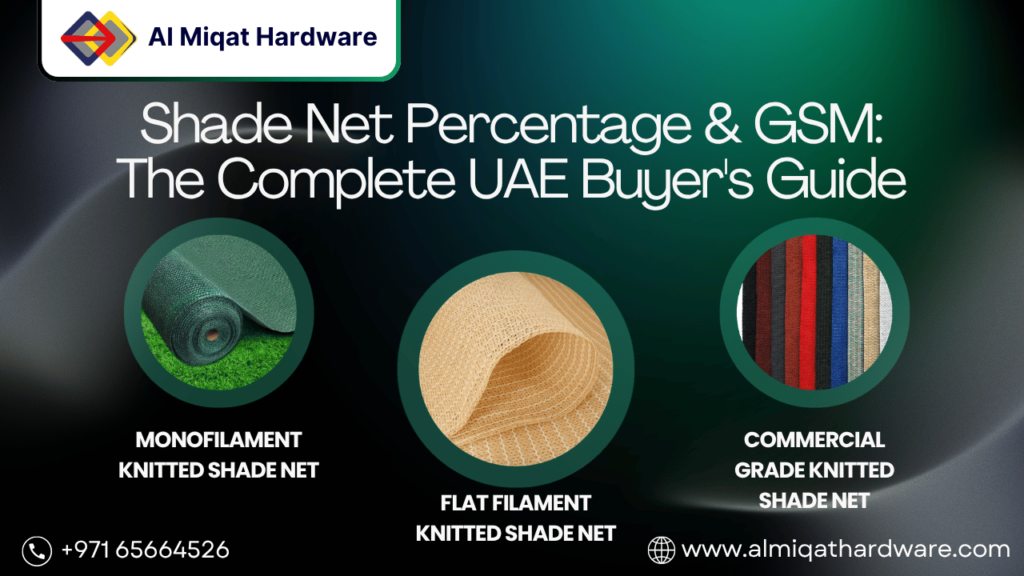
Choosing a shade net comes down to two numbers most buyers get wrong: the shade percentage and the GSM. Get them right and your net protects cars, crops or people for years. Get them wrong and you either cook what’s underneath or pay for a net that sags and fails in a single Gulf summer. This guide explains both, with clear recommendations for UAE conditions.
What "shade percentage" actually means
Shade percentage is simply how much sunlight the net blocks. A 90% shade net blocks 90% of the light and lets 10% through; a 50% net blocks half. Nets are commonly made from 30% all the way up to 95%, and the right figure depends entirely on what’s underneath.
The mistake is assuming “more is always better.” For people and parked cars, high blocking is ideal. For plants, too much shade starves them of the light they need to grow — which we’ll come back to below.
Shade percentage by use (quick reference)
- Car park shades: 90–95% — maximum heat and UV blocking for vehicles and people.
- Privacy & construction screening: 80–95% — visual blocking and dust control.
- Swimming pools & seating areas: 80–90% — comfort without total darkness.
- Nurseries & sensitive/young plants: 50–75%.
- Greenhouses: typically 40–60%, adjusted by crop and season.
- Leafy vegetables & most crops: 30–50% — they still need plenty of light.
Browse the matching products in our shade netting range, and for outdoor/parking use see commercial-grade knitted shade net.
GSM: the number that decides how long your net lasts
GSM means grams per square metre — the weight of the fabric. It’s the best single indicator of how dense, strong and durable a shade net is. Two nets can both say “90%,” but the heavier-GSM one has more material, resists tearing and UV breakdown better, and lasts longer.
As a rule of thumb:
- Lower GSM (lighter): cheaper, fine for short-term or light-duty use.
- Higher GSM (heavier): more durable, holds tension better, longer service life — worth it for permanent car-park and commercial installations.
When you compare quotes, always compare shade % and GSM together — a cheap net is often cheap because the GSM is low. See the differences between knitted grades on our monofilament and flat filament pages.
What shade percentage should you choose for a UAE summer?
The Gulf is a harsh case: extreme heat, intense UV and long sun hours. That pushes most recommendations upward:
- Car parks, walkways, people: go 90–95%. Anything less and surfaces still get dangerously hot.
- Outdoor living, pools, shaded yards: 80–90%.
- Crops and nurseries: stay in the agricultural ranges above (30–75% by crop) — don’t over-shade just because it’s hot, or you’ll cut yield.
Two non-negotiables for the UAE climate: choose UV-stabilised HDPE (untreated net turns brittle within a season here), and don’t skimp on GSM — the sun degrades thin nets fast. A correctly specced, UV-treated, higher-GSM net is the difference between replacing it yearly and getting many years of service.
How shade percentage affects plant growth
For agriculture, shade percentage is a growing decision, not just a comfort one. Plants need light for photosynthesis, so over-shading directly reduces growth and yield. The goal is to cut heat stress and water loss without starving the plant of light:
- Leafy greens and many vegetables do well at 30–50% — enough heat relief while keeping strong light.
- Nursery stock and shade-loving plants prefer 50–75%.
- Flowering crops (floriculture) vary by species and stage — too much shade delays flowering.
Match the percentage to the crop’s light needs, not to how hot the day feels. For deeper agricultural guidance, see shade netting for agriculture.
Putting it together: a 30-second decision
- What’s underneath? People/cars → 90–95%. Crops → 30–75% by crop type.
- How long must it last? Permanent/commercial → higher GSM, UV-stabilised HDPE.
- What’s the climate? UAE summer → lean to the top of each range and never skip UV treatment.
Still unsure? Tell us the use and area and we’ll spec the exact percentage, GSM and net type. Request a quote or message us on WhatsApp.
Related guides
FAQ
90–95%, for maximum heat and UV protection of vehicles and people.
Most leafy vegetables do well at 30–50% — enough to reduce heat stress while keeping the light plants need.
Higher GSM lasts longer; for permanent car-park or commercial use, choose a heavier GSM, UV-stabilised net rather than the cheapest option.
Usually yes — denser knitting uses more material — but the bigger price driver is GSM and UV treatment, which determine how long the net survives the Gulf sun.