

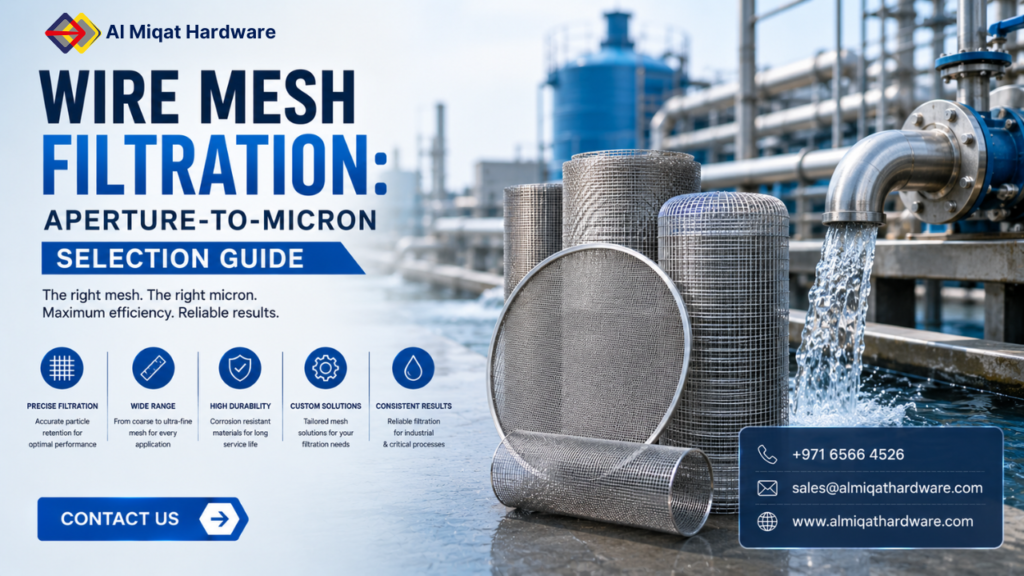
Two mesh specs that look similar on paper can behave very differently in filtration. Mesh count (openings per inch) tells you how tightly woven the mesh is, but the actual filtration performance is best described by the micron rating — the approximate particle size the mesh will hold back. Specifying by micron rating, not just mesh count, avoids mismatches between what a buyer expects and what the mesh actually delivers.
Roughly how mesh count relates to micron rating
As a general guide (actual values vary by wire diameter and weave):
| Mesh count (per inch) | Approx. aperture | Approx. micron rating | Typical use |
|---|---|---|---|
| 4–10 | 2–5 mm | Coarse — thousands of microns | Coarse screening, aggregate |
| 20–40 | 0.4–0.9 mm | ~400–900 microns | General sieving |
| 60–100 | 0.15–0.25 mm | ~150–250 microns | Fine sieving, food processing |
| 150–200 | 0.075–0.1 mm | ~75–100 microns | Fine filtration |
| 250–400 | 0.037–0.06 mm | ~37–60 microns | Precision filtration |
(These are approximate — always confirm the exact micron rating against the specific weave and wire diameter of the product you’re ordering, not mesh count alone.)
Weave type also affects filtration precision
- Plain weave — simplest construction, suited to coarser to mid-range filtration.
- Twill weave — allows finer, higher mesh counts with the same wire diameter, useful when you need finer filtration without excessively thin (weak) wire.
- Dutch weave — uses different warp and weft wire diameters to achieve very fine, precise micron ratings for demanding filtration applications.
See our stainless steel woven mesh range for the weave and grade options we supply.
How to choose the right mesh for your filtration application
- Define the particle size you need to retain — this sets your target micron rating, not just a mesh count number.
- Consider flow rate needs — finer mesh filters more precisely but restricts flow more; coarser mesh flows faster but filters less finely. Balance the two against your process requirement.
- Choose the material grade for the environment — stainless 304 or 316 for corrosive or hygienic environments; see our galvanized vs stainless guide.
- Confirm actual test data from your supplier — don’t rely on mesh count alone; ask for the micron rating and, where critical, test certification.
For general sizing terminology, see our gauge and mesh size guide.
Get the right filtration mesh
Tell us the particle size you need to filter and the application, and we’ll recommend the right mesh count, weave and material. Request a quote or message us on WhatsApp.
FAQ
What micron rating do I need for my filter?
It depends on the smallest particle size you need to retain — finer filtration needs a higher mesh count and smaller aperture, which typically means a lower flow rate.
Is mesh count the same as micron rating?
No — mesh count is openings per inch; micron rating is the approximate particle size retained. Two meshes with the same count can have different micron ratings depending on wire diameter and weave.
Which weave gives the finest filtration?
Dutch weave typically achieves the finest, most precise micron ratings, followed by twill weave, then plain weave.