

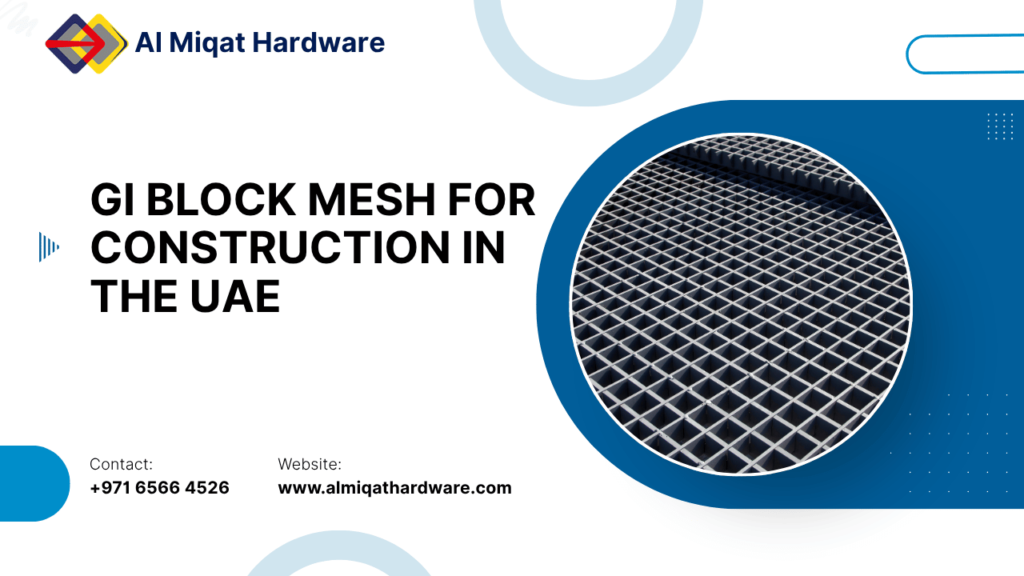
GI Block Mesh: The Quiet Workhorse of UAE Block Walls
Walk past any block-wall construction site in the UAE and there’s a good chance steel mesh is doing invisible work inside the wall. GI block mesh — galvanized steel mesh laid into the mortar joints of block and brick walls — is one of the most widely used and least talked-about products in masonry construction. This guide explains what it is, why builders specify it, the sizes and gauges to know, and how to buy the right one.
What is GI block mesh?
GI block mesh is a strip of galvanized (zinc-coated) steel wire mesh that is laid horizontally into the mortar bed joints between courses of concrete blocks or bricks. As the wall is built, the mason places a strip of mesh in the mortar every few courses; the next course is laid on top, locking the mesh into the wall. It’s sometimes called block-work mesh, brickforce, or coil/ladder mesh depending on the pattern.
Crucially, this is not the same as the chicken-wire mesh used for surface plastering. Plaster mesh sits on the outside of the wall to key render and control plaster cracking. GI block mesh is buried inside the wall to reinforce the masonry itself. For surface work, see our note on hexagonal wire mesh; for in-wall reinforcement, read on.
Why builders use it
Block and brick walls are strong in compression but weak in tension, which is where cracks start. GI block mesh addresses this:
- Crack control — it distributes stress along the wall and resists the shrinkage and thermal-movement cracks that are common in the UAE’s hot, dry climate.
- Reinforcement over openings — courses above doors and windows are vulnerable; mesh strengthens them.
- Tying long or tall walls — it adds horizontal tensile strength to boundary walls, partitions and infill walls.
- Junctions — it reinforces the weak point where block walls meet RCC columns and beams.
Because it’s galvanized, it resists the corrosion that humidity and coastal salt air would otherwise cause inside the wall — important for long-term durability in the Gulf.
Sizes and gauges to know
GI block mesh comes in rolls, in widths chosen to suit the block thickness — common widths run from around 60 mm up to roughly 200 mm so the mesh sits within the wall without protruding. Wire gauge varies by application; heavier gauges give more reinforcement for structural or load-bearing walls, while lighter gauges suit partition walls. When you order, specify the block width, wall type, and how many courses apart the mesh will be laid, and we’ll match the right width and gauge.
For help reading gauges and openings, see our guide on choosing the right gauge and mesh size.
Galvanized vs uncoated
Uncoated steel mesh inside a wall will eventually rust, expand, and crack the very masonry it was meant to protect. Galvanizing prevents this, which is why GI (galvanized) is the standard for block mesh. For especially aggressive or coastal exposure, ask about heavier coatings or stainless options. Our galvanized welded wire mesh range and GI wire are produced for exactly these conditions.
How it's installed
The mason lays a bed of mortar, places the mesh strip into it (kept back slightly from both wall faces), then lays the next course on top. It’s typically repeated every few courses, and always over openings and at junctions. Correct lapping at joints and corners matters — overlap strips rather than butting them.
Buying GI block mesh in the UAE
Quality varies widely, so confirm the galvanizing, the gauge, and the width before ordering, and buy from a supplier who holds stock for fast site delivery. Al Miqat Hardware has supplied galvanized mesh products across the UAE since 2005.
Tell us your block size and wall type and we’ll recommend the exact specification. Request a quote or message us on WhatsApp.
FAQ
No — block mesh goes inside the mortar joints to reinforce the wall; plaster mesh sits on the surface to support render.
Typically every few courses, and always over openings and at wall-to-column junctions — follow your engineer’s drawings.
Uncoated mesh rusts inside the wall and can crack the masonry; galvanizing prevents corrosion in the UAE climate.