

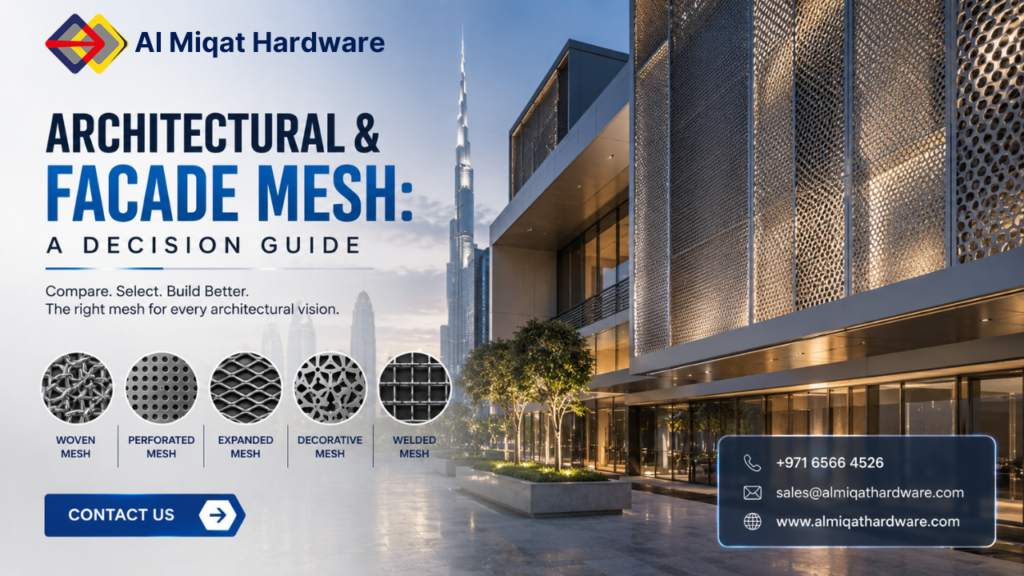
The three main options for architectural and facade mesh are expanded metal (bold, industrial-modern texture), perforated metal (precise, patterned, customisable openings), and woven stainless mesh (fine, flexible, elegant drape). The right choice depends on the visual effect, the amount of shading/airflow needed, and the budget. This guide compares them so you can choose with confidence.
Why architectural mesh has become popular in the UAE
Metal mesh facades give architects a way to control sunlight and heat, add visual texture, and create a modern, distinctive building skin — all relevant in the UAE’s climate and design culture. But “architectural mesh” isn’t one product; it’s a category, and picking the right material makes a real difference to cost, appearance and performance.
Expanded metal mesh
Made by slitting and stretching a solid sheet into a diamond pattern, expanded metal is a single, joint-free piece with a bold, industrial-modern look. It offers a strong strength-to-weight ratio, good airflow and shading, and a distinctive raised texture that reads well from a distance. We cover this in depth in the role of expanded metal mesh in modern architecture and our expanded mesh product range.
Best for: bold facade statements, sunshades, large-scale cladding.
Perforated metal mesh
Perforated sheet is a solid sheet punched with a pattern of holes — round, square, slotted or custom. Because the pattern is precisely controlled, it gives architects the most design flexibility: logos, gradients and custom patterns are all achievable. See top applications of perforated metal sheets and our perforated metal range.
Best for: precise, custom or branded facade patterns; balustrades and screens where a refined look matters.
Woven stainless steel mesh
Woven mesh — fine stainless steel wires interlaced on a loom — gives a soft, flexible, almost fabric-like appearance, and can drape over curved surfaces in ways rigid sheet materials can’t. It suits interior features, decorative screens and security-integrated facades. See using metal mesh in interior design, the unseen shield: stainless mesh in security systems, and our stainless steel woven mesh range.
Best for: curved or draped facades, interior features, combined security-and-aesthetic applications.
Comparison at a glance
| Factor | Expanded metal | Perforated metal | Woven stainless |
|---|---|---|---|
|
Look |
Bold, industrial texture |
Precise, custom pattern |
Soft, fabric-like drape |
|
Design flexibility |
Moderate |
High (custom patterns) |
High (can curve/drape) |
|
Airflow/shading |
Good |
Fully controllable by hole size |
Good, adjustable by weave density |
|
Typical cost |
Lower–moderate |
Moderate–higher (custom tooling) |
Moderate–higher |
|
Best application |
Large facades, sunshades |
Branded/patterned screens |
Curved surfaces, interiors, security-integrated |
How to choose
- Want a bold, cost-effective statement over a large area? Expanded metal.
- Need a specific pattern, logo or precise light control? Perforated metal.
- Working with a curved surface or want a softer, refined look? Woven stainless.
- Combining security with aesthetics? Woven stainless or expanded metal, both used in security-integrated facades.
For sustainability-led projects, our post on expanded mesh in sustainable construction is also worth a read, and for future direction see future trends in stainless steel mesh & fencing systems.
Get the right material for your facade
Tell us the design intent, the surface (flat or curved) and the scale, and we’ll recommend the right material and specification. Request a quote or message us on WhatsApp.
FAQ
Which mesh is best for a modern facade?
It depends on the look you want — expanded metal for a bold industrial texture, perforated metal for precise custom patterns, or woven stainless for a soft, draped appearance.
Can architectural mesh curve around a building?
Woven stainless mesh drapes and curves most easily; expanded and perforated sheet are generally used flat or gently curved.
Is architectural mesh expensive?
Expanded metal is typically the most cost-effective for large areas; perforated metal costs more for custom tooling; woven mesh varies by wire gauge and weave density.