

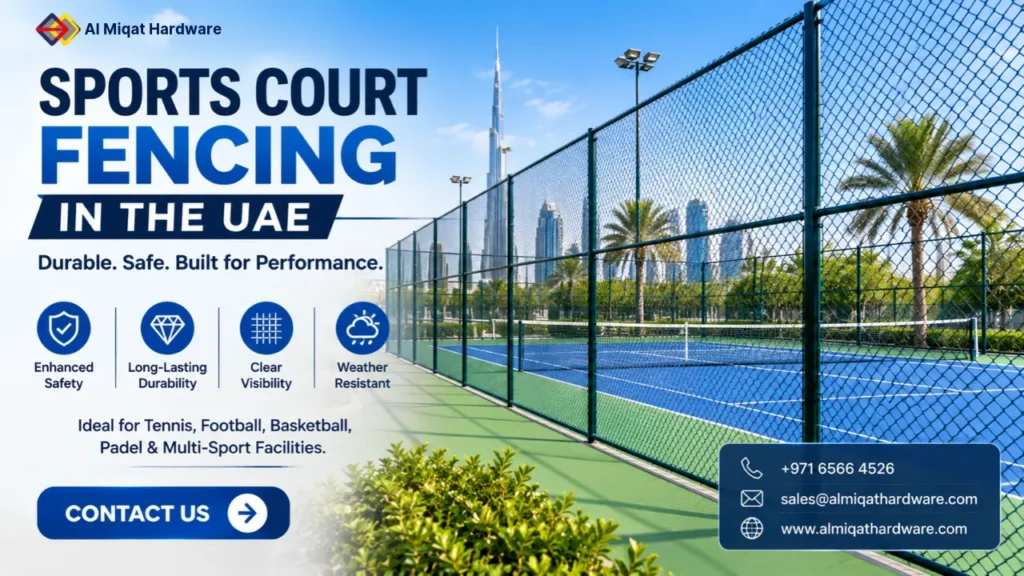
Most sports courts in the UAE are enclosed with PVC coated chain link fencing or rigid welded mesh panels. Chain link is economical and flexible for large enclosures; welded panels give a flatter, more rigid finish. Whichever you choose, specify a heavy enough gauge for ball impact, a PVC or galvanized finish that survives UAE heat and humidity, and safe, knuckle-finished edges. Request a quote or message us on WhatsApp.
Why court fencing is its own specification
A sports court fence isn’t just a boundary. It has to absorb repeated ball impact, stay taut for years, look tidy to players and spectators, and resist heat, humidity and sometimes coastal salt air. A fence chosen only on price tends to sag, rust or deform within a couple of seasons.
Chain link or welded mesh panels?
PVC coated chain link is the long-standing choice for tennis and multi-sport courts. It is flexible, cost-effective over large areas and forgiving of ball impact. A 50 mm opening is a common size for sports enclosures. See our chain link fencing range and guide to chain link types, styles and customization.
Rigid welded mesh panels give a flatter, more modern look and hold their shape well, which suits padel and compact courts. Padel enclosures typically combine glass walls with rigid steel mesh panels on a court of 20 m × 10 m, so follow your court builder’s or federation’s specification for wall layout and heights. See our PVC coated welded mesh and 3D curved PVC coated mesh panels.
Choosing height and gauge
Fence height depends on the sport and the court design. Tennis enclosures are commonly around 3 m, often higher behind the baselines, and multi-sport and football courts are often taller to stop balls leaving the pitch. Check the requirement for your facility. For general guidance, see choosing the right height for your fence.
For gauge, go heavier than you would for a garden fence. Balls hitting the same panel thousands of times will loosen light wire quickly.
The finish: built for UAE conditions
- PVC coating over galvanized wire gives two layers of corrosion protection, which matters in humid and coastal areas. See why PVC chain link suits coastal and humid areas.
- Colour: green is the standard, and black or dark green is often preferred because it blends into the background and can improve ball visibility. Other colours are available on request.
- Safe edges: specify knuckle-finished (smooth, folded) edges at top and bottom so players are not exposed to sharp wire ends.
Posts, tension and wind
A court fence is only as good as its posts and tensioning. Use correctly sized posts, set them properly and tension the mesh evenly so it doesn’t sag over time. Read our guides on preventing fence sagging and wind load for open sites, and avoid the pitfalls in common mistakes when installing chain link fencing.
Who needs this
Residential compounds and villas with private courts, hotels and resorts, schools and academies, sports clubs and padel and tennis facilities, and community or municipal developments.
Specify it right
Tell us the sport, the court size, the height you need and whether the site is coastal or inland, and we’ll recommend the mesh type, gauge and coating. Request a quote.
FAQ
Padel courts typically use a mix of glass walls and rigid steel mesh panels. Wall layout and heights should follow your court builder’s or federation’s specification.
Yes. PVC coated chain link is a long-established, cost-effective choice for tennis and multi-sport courts, provided the gauge, posts and tension are right.
Green is standard. Black or dark green is often chosen because it blends into the background and helps ball visibility.
A PVC coated, galvanized fence resists humidity and coastal air far better than bare steel. Specify PVC over galvanized wire for long life.