

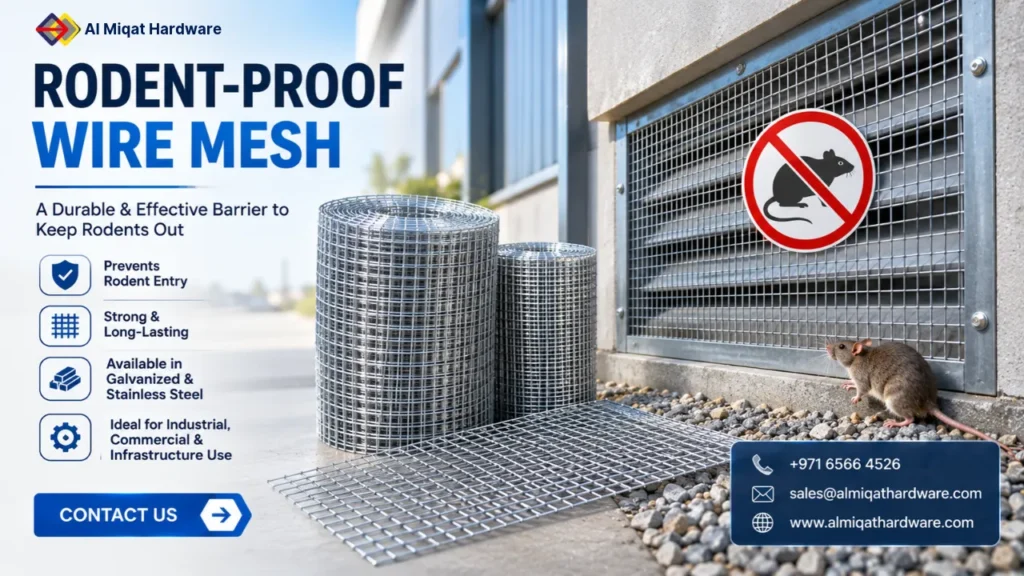
To keep rats and mice out, use welded or woven steel mesh with openings small enough to block them (roughly 6 mm / 1/4 inch for mice and 12 mm / 1/2 inch for rats) in galvanized or stainless steel, fixed securely with no gaps. Plastic netting, soft aluminium screen and light chicken wire are not reliable, because rodents can chew, pry or squeeze through them. Request a quote or message us on WhatsApp.
Why opening size is the first spec to get right
Rodents fit through far smaller gaps than most people expect. As a rule of thumb, a mouse can squeeze through an opening of about 6 mm, and a rat through roughly 12 mm. If young rodents are a concern at your site, go to the smaller size. A mesh that is “nearly” the right size is the most common reason rodent-proofing fails.
Which materials actually work
- Galvanized welded mesh: rigid, strong and economical, and the usual choice for vents, storerooms and warehouse openings. See our galvanized welded wire mesh.
- Stainless steel (304) woven or welded mesh: the right choice for food processing and hygiene-sensitive areas, where smooth, cleanable, corrosion-free material matters. See stainless steel woven mesh and our guide to stainless steel mesh in food processing plants.
- PVC coated welded mesh: useful in humid or coastal locations. Note that the steel wire inside is what stops the rodent; the PVC is there to protect against corrosion. Our PVC coated welded mesh is listed in 1/4 inch (6.4 mm) and 1/2 inch (12.7 mm) openings.
What to avoid: plastic netting (easily chewed), aluminium fly screen (too soft) and standard chicken wire. Hexagonal wire mesh is excellent for poultry, plastering and garden work, but its openings are typically 25 mm or larger and the wire is flexible, so it is not a dependable rodent barrier.
Where rodent-proof mesh is used
- Warehouses and food storage: openings, louvres and ventilation gaps.
- Air vents, exhaust openings and ducts: where pests use air paths to get inside.
- Roof eaves, soffits and gaps around pipes: common entry points in villas and commercial buildings.
- Plant, generator and electrical rooms: rodents chew cables, so keeping them out protects equipment.
- Farms and feed stores: protecting stored feed and grain.
For pest and debris protection around rooftop solar, see our posts on bird guard mesh for solar panels and specialized mesh under rooftop solar arrays.
Getting the installation right
The best mesh fails if it is fitted badly. Follow these basics:
- Measure the full opening and cut the mesh larger than the hole so it can be fixed to solid surfaces.
- Fix at close intervals with screws and washers or clamps so there is no flexing gap at the edges.
- Overlap joins rather than butting two pieces together.
- Seal corners and edges, because rodents test every gap.
- Protect cut edges of galvanized mesh with a zinc-rich coating so rust doesn’t start at the cut.
Our guides on installing wire mesh and cutting and shaping mesh without damage cover the practical side.
Food and hygiene sites
Food storage and processing facilities usually have strict pest-control requirements, so check what your facility, auditor or local authority expects before you choose a material. Stainless steel is generally the safest specification in these areas because it is smooth, easy to clean and does not flake. For wider context see stainless steel mesh in hygiene-critical industries.
Quick selection table
| Target | Suggested opening | Material | Typical use |
|---|---|---|---|
|
Mice |
about 6 mm (1/4") |
Galvanized or stainless |
Vents, storerooms, cable openings |
|
Rats |
about 12 mm (1/2") |
Galvanized or stainless |
Warehouse openings, plant rooms |
|
Insects and rodents |
Fine woven stainless over welded backing |
Stainless 304 |
Food areas, ventilation |
Get the right mesh for your site
Tell us what you are protecting, the opening size you need and where it will be fitted, and we’ll recommend the mesh and quote it. Contact us.
FAQ
An opening of about 12 mm (1/2 inch) or smaller blocks adult rats. For mice, use about 6 mm (1/4 inch). Where both are a risk, use the smaller size.
No. Chicken wire has larger openings (typically 25 mm or more) and flexible wire that rodents can bend or chew. Use welded steel mesh with small openings instead.
Stainless steel 304 is the most hygienic choice. Galvanized welded mesh works well for vents and storerooms where food hygiene rules are less strict.
They can chew the plastic coating, but the steel wire underneath is what stops them. Choose a suitable steel gauge and opening size.